|
OGDEN VALLEY CITY
Truth in Taxation Public Hearing
Frequently Asked Questions
Prepared in response to questions raised at the August 11, 2026, Truth in Taxation public hearing
This FAQ responds to the most frequently asked and implied questions from the City’s August 11, 2026, Truth in Taxation public hearing. Answers are drawn from the City’s FY27 Budget Book, the Property Tax Impact Schedule (updated 7-23-2026), the Interim Truth-in-Taxation/FY27 Budget, and applicable Utah statutes.
A. Big-Picture & “Why Are We Here?” Questions
Q1. Why is Ogden Valley City proposing such a large property tax increase (often described as ~500%)?
A: The percentage looks large because of what it is being measured against. Since incorporation, OVC has only received the old Unincorporated Services Fund rate — the same rate Weber County charged before the City existed — generating an estimated $489,519 a year. The proposed rate would raise the City’s own certified rate from .000159 to .000953, producing $2,475,138 in additional revenue, a 512.61% increase over that starting base. In dollar terms, for a typical residence (market value $1,222,000, taxable value $672,100), the City’s portion of the annual property tax bill would rise from $104.85 to $640.51 — an increase of $535.66 per year (about $44.64/month). For a commercial property of the same value, the City’s portion would rise from $190.63 to $1,164.57, an increase of $973.94 per year.
Q2. What changed between the original incorporation feasibility study and the current financial reality?
A: Two things moved in the wrong direction at once. First, the feasibility study’s sales tax projections were based on COVID-era spending patterns, which were temporarily and artificially inflated and did not reflect normal, sustained growth — so actual sales tax revenue has come in below the original projections. For example, Sales Tax revenue will be around 1.4 million, about $900K short of LRB study. Second, the feasibility study underestimated and failed to even identify the real startup costs of standing up a new city, including general plan, a new land-use code, impact fee studies, storm water management plan, and other costs a new city faces. Expenses are significantly more than the study. The combination of lower-than-projected revenue and higher-than-projected expenses is what created the funding gap the Council is now addressing. As another consideration, some projections were questionable. For example, the administration costs in the study were estimated using the County figure of $29.54 per capita, when the average comparative cities in the study reported administration costs of $76.74 per capita. The City is not accusing – nor does it have a basis – for suggesting the report was rendered in bad faith. Rather, it appears there were different accounting practices that ended up with an erroneous projection of actual costs.
Q3. What are we getting for this tax increase that we weren’t getting from Weber County?
A: As an unincorporated area, the Valley’s land use, building permitting, road maintenance, and public works decisions were made at the County level, alongside every other unincorporated part of Weber County. Incorporation shifted those functions to locally elected Council and dedicated City departments. Incorporation provides local control of key issues: land use decisions, short-term rental regulation, code enforcement, and gaining a seat at the table for the Olympics, grants, and other opportunities – all benefits of incorporation. We will actually be getting the services needed to protect the valley, as determined by the valley. Before incorporation, there were complaints that county code enforcement was inadequate. The tax increase budgets for actual code enforcement focused on Ogden Valley issues. We inherited roads at the end of their lifespan. The city will be able to catch up with road maintenance over time. Previously, storm water issues were not adequately addressed. The budget increase provides this critical service. The tax increase funds the local staff, contracted services, and infrastructure work needed to deliver those functions directly, rather than as one part of a countywide unincorporated services budget.
Q4. Isn’t this “double taxation”? We already pay Weber County for services like roads and snow removal — why are we paying more on top of that?
A: The City’s proposed rate replaces, rather than adds to, the County’s Unincorporated Services Fund rate residents previously paid for those same functions — the Property Tax Impact Schedule shows the comparison is City rate vs. prior County rate, not City rate plus County rate. Residents still pay the County, school district, and other special district portions of their property tax bill separately; those are outside the City’s control and are not part of this proposal. The money residents will continue paying the county is for County general fund services (which are separate from municipal services). Think of it as we used to pay two lines to the county; now we pay one to the city and one to the county. The services paid for by the line items are separate and do not overlap. For context, the City’s proposed municipal rate would rank roughly 8th of 15 Weber County municipalities on the County’s own rate comparison — below South Ogden, Ogden, Washington Terrace, Roy, Harrisville, Riverdale, and North Ogden, and above Pleasant View, Huntsville, Uintah, Farr West, Hooper, and Plain City. Whether any specific service is being paid twice (for example, roads maintained privately by an HOA) isaddressed in Question 15 below. B. Incorporation, Disincorporation, and “Can We Go Back?”
Q5. Given what we now know about the city’s finances, is it possible to disincorporate Ogden Valley City and return to Weber Countygovernance? If so, what is the process and timeline?
A: Disincorporation is a legal process under Utah Code §§ 10-2-701 through 10-2-712, and it is initiated by citizens, not the Council. A petition must carry signatures equal to 25% of all votes cast in the municipality at the last congressional election, is validated by the County Clerk, and is then filed with the district court. If the court finds the petition valid and complete, it must schedule a special election on dissolution 60 to 90 days later; dissolution requires a majority “yes” vote, after which the court oversees winding down the City’s affairs, resolving claims, and returning governance to the County. Critically, state law bars a court from even considering a disincorporation petition filed less than two years after the municipality’s official incorporation date (Utah Code § 10-2-710). Because OVC’s Certificate of Incorporation issued on January 2, 2026, the earliest a disincorporation petition could legally be filed with the court is January 2, 2028.
Q6. If we disincorporated, would we get the same level of county services and tax treatment we had before, or has that situation changed permanently?
A: This would depend on Weber County’s staffing, budget, and policy at whatever future pointdisincorporation might occur — none of which the City can predict or guarantee today. One relevant statutory point: under Utah Code § 10-2-712(3)(b), the County generally cannotresume levying property tax, assessments, or fees within the former city’s boundaries unless it was already doing so immediately before dissolution, until dissolution documents are formally recorded. Beyond that, a resident considering this question should not assume county service levels or tax treatment would simply revert to pre-incorporation conditions.
Q7. Can the city petition the Lieutenant Governor’s Office and/or the Legislature to request a waiver or special relief, and/or fund or authorize a new feasibility study and revote on incorporation?
A: There is no existing statutory process for a general “waiver” from the Lieutenant Governor’s Office or an administrative do-over of a feasibility study and incorporation vote; the Lieutenant Governor’s role in Title 10, Chapter 2 is limited to processing and certifying incorporation and dissolution filings, not granting relief from a city’s tax or budget situation. The City’s legal effort in this area is the Truth-in-Taxation litigation against the Utah State Tax Commission, which challenges the Tax Commission’s exclusion of OVC from the 2026 property tax cycle because the Certificate of Incorporation was issued one day after the controlling January 1 lien date. Separately, a legislative fix addressing that same lien-date gap for newly incorporated cities could be pursued through the Legislature in a future session; that would be a new policy request to lawmakers, not an existing remedy the City can invoke today. Mayor Wampler has been asked to report to the legislature on the many flaws in the current incorporation and new city startup process.
C. Nature and Duration of the Tax Increase
Q8. Is this proposed tax increase a one-time “gap year” measure because of the January 2 property tax filing issue, or is it a permanent ongoing increase?
A: The rate increase itself is not structured as a one-time event. It is built into the City’s ongoing FY27 operating budget and funds continuing functions — Class C road maintenance, Administration, Public Safety contracting, Public Works, Building, and Community Development — not a single-year gap payment. Several expenditure lines are labeled “Restricted Tax Increase Reserve,” meaning that money can only be spent if the tax increase is approved, and it is allocated across ongoing departmental budgets rather than a one-time project. The underlying trigger — the City’s exclusion from the 2026 Truth-in-Taxation cycle because incorporation occurred one day after the January 1 lien date — was a one-time timing issue, but the budget built around this proposed rate funds recurring annual operations.
Q9. Once the city can legally levy and collect its own property tax in a normal way, will this rate be reduced or “sunsetted,” or will residents be locked into this higher rate indefinitely?
A: The current budget materials do not include a built-in sunset or automatic reduction for property tax. Under Utah’s Truth-in-Taxation law, the City’s certified tax rate is reviewed and set through an annual public process, and any future increase or decrease in the rate would again require public notice and a hearing. Whether the rate should be reduced once the City has a full year of normal Truth-in-Taxation participation and better data on actual costs and revenue is a policy question for a future Council to take up in a future budget cycle — it has not been decided or ruled out at this time. It’s worth noting that the Municipal Energy Tax (MET) and the Transportation Utility Fee (TUF) were both stopgaps adopted in light ofinsufficient property taxes to fund municipal services.
Q10. Could this increase be structured or framed as a temporary “assessment” or time-limited measure rather than a permanent tax rate hike?
A. A special assessment is a legally distinct tool from a property tax rate . Assesments are generally tied do specific improvements that benefit specific parcels (for example, a special improvement district for a particualr road or utility project), not general city operations like administraton, public safety, or ongoing road maintenance across the whole cityl because the funding gap addressed by this proposal covers general operating costs rather than a defined, benefit-specific capital project, it would not fit the legal framework for an assessment. The property tax rate proposal is being pursued through the standard Truth-in Taxation proces rather than the assessment process for that reason.
D. Budget, Staffing, and Use of Funds
Q11. Why is the administrative budget increasing so much compared to relatively modest increases in road and public works budgets?
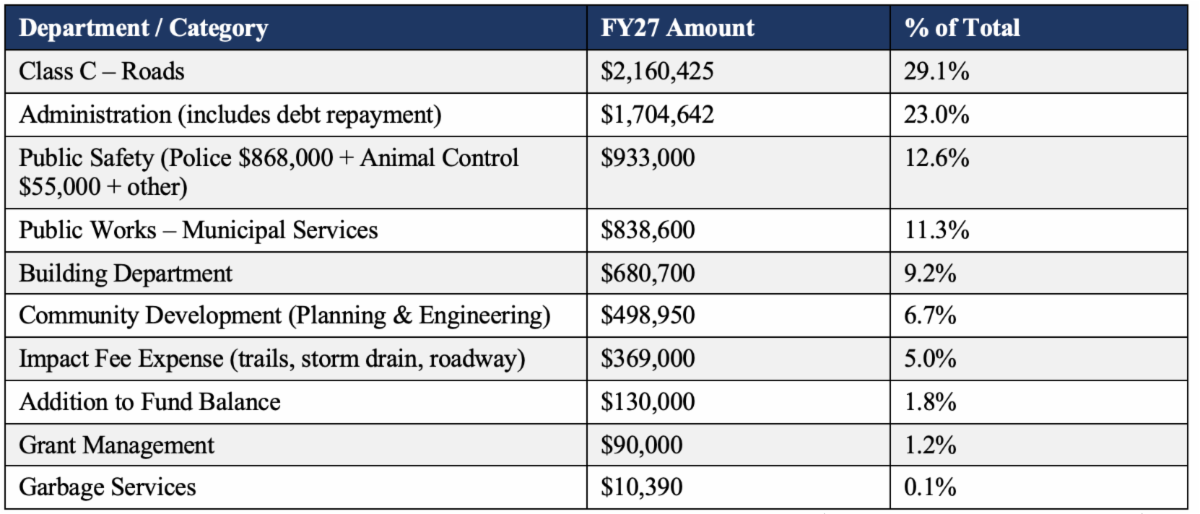
A: Two things are worth separating. First, Class C Roads is actually the single largest category in the FY27 budget at $2,160,425 (29.1%) of total expenditures — larger in dollar terms than Administration. Second, a substantial share of the Administration total of $1,704,642 (23.0%) is debt service, not staff or overhead: $875,000 in Debt Service – Principal, $17,132 in Debt Service – Interest, and $34,500 in Bond Issuance Costs — together roughly $926,632, or more than half of the Administration line — relates to borrowing (a Tax Anticipation Note) the City has used to bridge cash flow while property tax revenue is delayed, not to staffing growth.
Q12. What positions are being added, and why are they needed now?
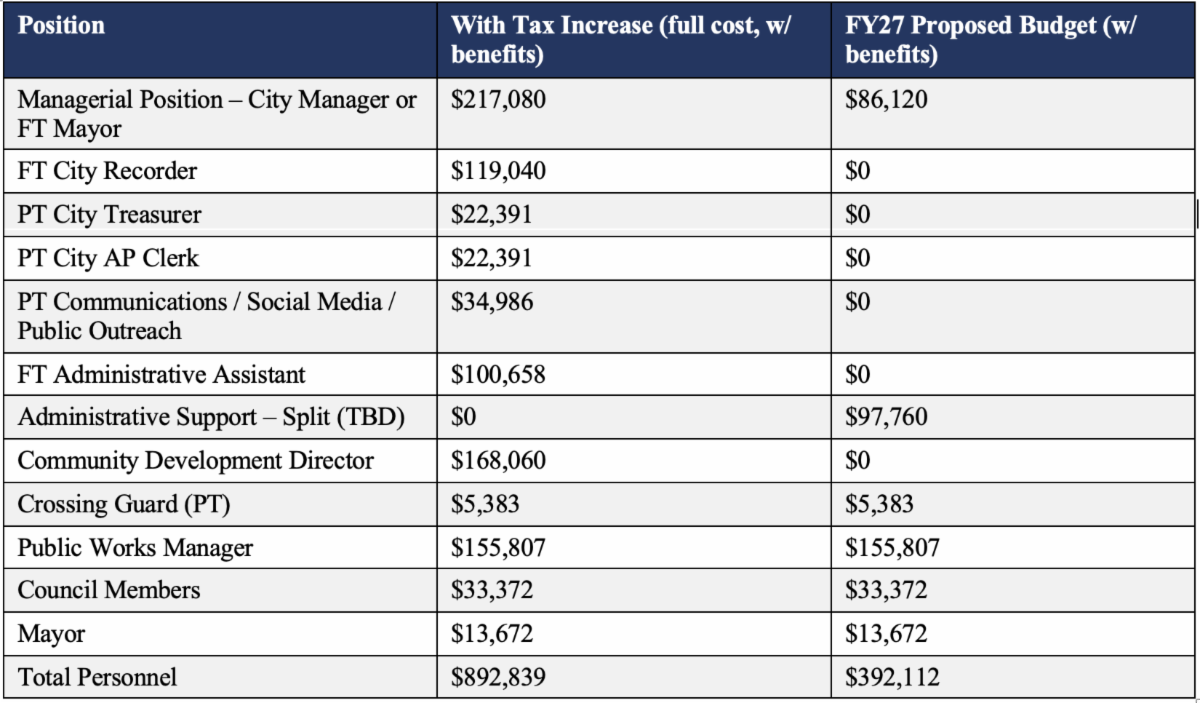
A: The Personnel section of the FY27 Budget Book identifies the following proposed positions, with costs shown both under the fully tax-increase-funded Interim Truth-in-Taxation scenario and the reduced FY27 Proposed Budget scenario:
|